
About us
Sexual Violence Prevention and Education works to build awareness about sexual violence and gender-based violence on campus and make accessible the supports and services for those who are affected. The Sexual Violence Prevention and Education Coordinator provides support to survivors, students, staff and faculty.
Our services are available to all members of the Lakers community, including undergraduate, graduate, and continuing education students, staff, and faculty.
If you have experienced sexual violence, please know that the Sexual Violence Prevention and Education Coordinator is available to listen, support, and help you navigate the next steps in non-emergency situations. If you feel you are in danger, contact 911.
Consent Belongs Here is Nipissing University’s campaign to end sexual violence through education, prevention and outreach. Consent Belongs Here will be organizing events and initiatives on campus focused on sexual violence prevention and education throughout the year.
Sexual Violence Prevention and Education provides information and guidance for any community member on the policy, procedures, programs, and referral to campus and community services and resources.
Workshops & Events
To find workshops and events we offer, check the Training and Events page.

Explore Support Services
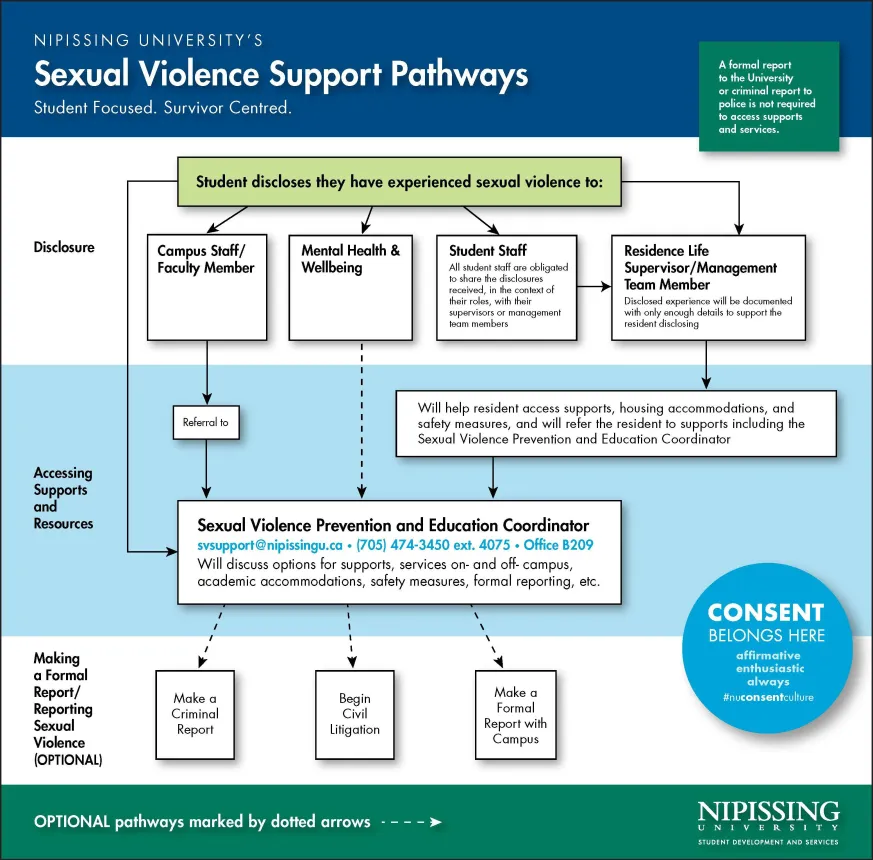
If you have experienced sexual violence or are supporting someone who has experienced sexual violence, the Sexual Violence Prevention and Education Coordinator is available to listen, support, and help you navigate the next steps in non-emergency situations.
If you are in immediate danger, contact 911.
- Office: Student Development & Services, B209
- Phone: 705-474-3450 ext. 4075
- Email: svsupport@nipissingu.ca
The Sexual Violence Prevention and Education Coordinator is available to all Nipissing University students who may seek support or information related to sexual or gender-based violence. Additionally, the Sexual Violence Prevention and Education Coordinator is available to consult with and provide resources and support to those who have received a disclosure.
What you can expect:
When connecting with the Sexual Violence Prevention and Education Coordinator, you can expect non-judgmental support for your disclosure and help to navigate the support options available, such as:
- consider safety measures that may be necessary;
- refers to medical services, as needed;
- actively and empathically listen to their needs and concerns without judgment;
- share reporting options available;
- clarify commitments to confidentiality and its limits;
- explain the difference between disclosure and reporting.
- make a referral to the police if the individual chooses that option
- assist with navigating any relevant University systems and procedures;
- facilitate academic and/or residential accommodations;
- provide information about and referral to campus and community services; and
- liaise with relevant partners to ensure coordinated response and support.
Mental Health & Wellbeing works to support all students in achieving positive mental and emotional wellness.
Nipissing University Mental Health & Wellbeing
- Office: B210
- Phone: 705-474-3450 ext. 4507
- E-mail: mhwellbeing@nipissingu.ca
- Website: www.nipissingu.ca/mhwellbeing
Amelia Rising Sexual Violence Support Centre provides free, completely confidential support for people 12 years of age and older who have experienced sexual or gender-based violence.
Amelia Rising – Sexual Assault Centre of Nipissing
101 Worthington St E., Suite 215
North Bay, Ontario, Canada, P1B 1G5
- Phone: 705-840-2403
- Fax: 866-253-7476
- Website: http://www.ameliarising.ca/
The Sexual Assault/Domestic Violence Program and Treatment Centre at NBRHC is an individualized service available to survivors of sexual assault, intimate partner violence. The program provides emergency health care and psychosocial support, and follow-up care by specially trained nurses.
North Bay Regional Health Centre – Sexual Assault Treatment Centre
50 College Drive
P.O. Box 2500
North Bay, ON
P1B 5A4
- Phone: 705-474-8600 ext. 4478
- Website: Sexual Assault Treatment Centre
- Good2Talk (Postsecondary Student Helpline): 1-866-925-5454
- Victim Support Line: 1-888-579-2888
- Mental Health Helpline (Health Services Information): 1-866-531-2600
- Support Services for Male Survivors of Sexual Abuse: 1-866-887-0015
- Assaulted Women’s Helpline: 1-866-863-0511
- Talk4Healing (Aboriginal Women’s Helpline): 1-855-554-HEAL (4325)
You may choose to report the sexual violence to the police. You may choose to do this whether or not you make a complaint with the University against the accused or not. Making a police report does not stop you from also making a complaint at the University against the accused.
The Sexual Violence Prevention and Education Coordinator is available to chat with you if you would like more information about either of these options or the next steps.
- North Bay Police Service: 705-472-1234
- 22 Wing Military Police: 705-494-2188
- Anishinabek Police Service: 705-472-0270
- West Nipissing Police Service: 705-753-1234
- Ontario Provincial Police (OPP): 1-888-310-1122
- Phone: 705-472-2649
- Email: info@vsnd.ca
- Website: www.vsnd.ca
VSND can support with:
- Immediate crisis intervention and emotional support.
- Safety planning and practical assistance following a crime or traumatic event.
- Referrals, system navigation, and ongoing advocacy.
Sexual violence is a traumatic experience. While every individual will react differently, the experience can have significant lasting effects and interrupt many aspects of a survivor's life. A supportive and non-judgemental initial response to disclosure can significantly impact the survivor's ability to seek further support.
If there is an imminent risk of harm:
(i.e., an immediate threat or risk of harm to a person, or an act of violence that is currently taking place)
- Call 911
- Call Campus Security 705-498-7244
- Mobile Blue Light on the Nipissing Safe App
Resources
Sexual Violence Prevention & Education Coordinator
The Sexual Violence Prevention and Education Coordinator is available to all Nipissing University students who may seek support or information related to sexual or gender-based violence. Additionally, the Sexual Violence Prevention and Education Coordinator is available to consult with and provide resources and support to those who have received a disclosure.
- Office: Student Development & Services - B209
- Email: svsupport@nipissingu.ca
- Phone: 705-474-3450 ext. 4075
Below are links to websites and resources. Please note, we do not own/maintain the information on these external links. These resources are available in print format from the Sexual Violence Prevention & Education Coordinator in office B209.
Looking for more information?
Contact the Sexual Violence Prevention & Education Coordinator:
- Office: Student Development & Services - B209
- Phone: 705-474-3450 ext. 4075
- Email: svsupport@nipissingu.ca
Healthy Relationships
- Healthy Relationships are About
- Is our Relationship Healthy? Quiz
- Relationship Spectrum
- LGBTQ Relationship and Dating Violence
- How to Set Boundaries
Sex Positive Resources
Human Rights & Consent Law
- Sexual Assault and Consent Law
- Ontario Human Rights Commission Sexual harassment and your education (fact sheet)
- Sexual orientation and human rights (brochure)
- Sexting & The Law
Sexual Violence
Consent
- Respect Sexual Consent - Brochure
- Consent is Like Tea - Video
- Consent 101 - Video Playlist
- Consent Checklist
- Rolling with Rejection
Sex, Gender and Sexual Orientation
- Gender Unicorn
- How to Understand Your Gender
- Gender identity and gender expression (brochure)
- Mapping your Sexuality
Safer Partying
Below is information on have a safer and fun night when consuming alcohol
- Stick with a group and watch out for each other. Plan to arrive together and leave together. If you decide to leave early, let your friends know that you’re leaving and when you arrive home safely.
- Keep your phone charged. Stay in contact with your group, use it to ger home, and in case of an emergency.
- Plan a safe way home. Have a sober friend available to drive, or plan your trip home with a taxi, Uride, or bus.
- Know what you’re drinking. Don’t recognize an ingredient? Use your phone to look it up. Consider avoiding large-batch drinks like punches that may have a deceptively high alcohol content and may have other ingredients added. If you choose to drink from a communal mix, let a friend know, take a slowly and listen to your body.
- Trust your instincts. If you feel unsafe, uncomfortable, or worried for any reason, don’t ignore these feelings. Go with your gut. Get somewhere safe and find someone you trust, or call Campus Security or the Police.
- Don’t leave a drink unattended. That includes when you use the bathroom, go dancing, or leave to make a phone call. Either take the drink with you, have a trusted friend hold it or throw it out. Avoid using the same cup to refill your drink.
- Be aware. Pay attention to your drink and what is going on around you.
- Consume with consent. Make sure everyone consents to each round and let everyone order and pick up their own drink.
- Check-in with yourself. You might have heard the expression, “know your limits.” Whether you drink regularly or not, check in with yourself periodically to register how you feel. If you think you have had too much, ask a staff member to help you get water or get home safely.
- Be aware of sudden changes in the way your body feels. You might have heard the expression, “know your limits.” Whether you drink regularly or not, check in with yourself periodically to register how you feel. If you think you have had too much, ask a staff member to help you get water or get home safely.
- Get help. If something doesn’t look right, step in. Don’t be afraid to let a friend know if you are uncomfortable or worried about their safety.
- Have a snack. Balance out alcohol consumption with drinking water and eating between drinks.
- If you are planning on consuming a lot, ensure you are with a friend in a safe place, and stick to one substance at a time.
Canada's Low-Risk Alcohol Drinking Guidelines can help you make informed decisions about drinking.
- Drink slowly. Aim for a maximum of 2 standard drinks in any 3 hours.
- For every drink of alcohol, have one non-alcoholic drink.
- Consider your age, body weight and health when setting your limits.
A standard drink is a measure of how much pure alcohol you are drinking. It varies based on the concentration of alcohol in a beverage.
In Canada, a standard drink is 17.05 millilitres or 13.45 grams of pure alcohol. This is the equivalent of:
- a bottle of beer (12 oz., 341 ml, 5% alcohol)
- a bottle of cider (12 oz., 341 ml, 5% alcohol)
- a glass of wine (5 oz., 142 ml, 12% alcohol)
- a shot glass of spirits (1.5 oz., 43 ml, 40% alcohol)
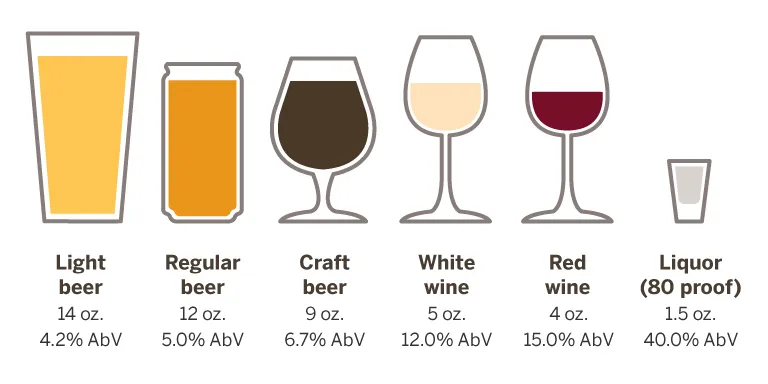
Image source: https://alcohol.iupui.edu/calculators/alcohol-serving-size.html
- Any substance that alters ones level of consciousness and / or physical ability to resist or fight back can be used to commit Drug-Facilitated Sexual Assault. Causing someone to ingest something without their awareness is called ‘drink-spiking’, ‘spiking,’ or non-consensual dosing. Alcohol is the most common substance used to facilitate DFSA.
- DFSA occurs when alcohol or other substances are used to intentionally sedate or incapacitate a person in order to perpetrate sexual assault. DFSA also makes a person more vulnerable to human trafficking, robbery, abduction and injury.
- Most often, the assumption of how DFSA occurs is when a perpetrator puts a drug into an unsuspecting victim’s drink. This is considered a ‘proactive’ DFSA.
- A ‘proactive’ DFSA also includes supplying someone with large quantities of alcohol with the intent to incapacitate them.
- An ‘opportunistic’ DFSA occurs when someone specifically targets an already intoxicated person.
Redflags
Redflags to watch out for when it comes to drink-spiking when someone is:
- Making 'jokes' or comments about getting people drunk in order to have sex with them.
- Pressuring others to drink faster, larger quantities, or stronger drinks.
- Targeting the most visibly intoxicated person in the space.
- Making or ordering drinks stronger than asked for.
- Trying to get an incapacitated person alone / away from friends, or outside of the space.
- Purchasing drinks for others with a sense of entitlement to attention or physicality in return.
- Pressuring people to do drugs.
- Flirting with people who are in need of care or support due to over intoxication.
(source: goodnightoutvancouver.com)
Signs and symptoms
Signs and symptoms that can accompany non-consensual dosing:
- Slurred Speech
- Dizziness
- Drowsiness
- Headache
- Passing out
- Vomiting
- Alert & aware but unable to move
- Someone saying something like "I shouldn't be this drunk" or "I've only had one drink."
- Missing parts or all of the evening
- Hangover doesn’t match amount drank
- Indicators of sexual assault
- conciseness (blacking out)
- Loss of memory
(source: goodnightoutvancouver.com)
If you have been a victim of drink spiking or non-consensual dosing, it is not your fault. Please see our Getting Help tab.