
Projects currently underway in the Forest Resources Laboratory
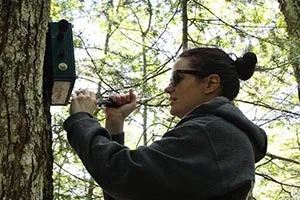
Mandy Ehnes (MESc.)
The ecological effects of an Emerald Ash borer infestation on avian and anuran diversity and signalling behaviour at a community scale in urban woodlots.
Co-supervised with Dr. Jennifer Foote, Department of Biology and Chemistry, Algoma University.
It is widely recognized that green spaces are important for recreation and promote healthy air and lifestyles. While imperative for human wellbeing, woodlots are also critical for providing habitat for wildlife. Urban woodlots act as islands for species that reside in the surrounding natural habitat. Emerald ash borer (EAB; Agrilus planipennis) is an invasive beetle to North America killing millions of healthy ash trees (Fraxinus ssp.) in the USA and Canada, leaving billions more at risk. Canopy changes can influence animal biodiversity and signalling behaviour in complex ways. Using innovative technologies I will illustrate how community membership can shift and species that remain in poor-quality habitat may show reduced signalling behaviour related to condition. First, I use automated recording technology and bioacoustics software to quantify bird composition and fitness. Second, EAB related canopy mortality is unprecedented in efficiency and speed, and as a result, current methods of quantifying canopy health may not fully capture complete canopy damage. My research uses unmanned aerial vehicle (UAV) technology to capture images of canopy mortality as a supplementary method of measuring canopy disturbance in relation to potential songbird habitat.
Tegan McWhirter (MESc.)
Assessing the Intensity and Behaviour of Past Forest Fires using the Oxygen-Isotope Composition of Char.
Co-supervised with Dr. Elizabeth Webb, Department of Earth Sciences, Western University.
Wildland fires play an integral role in healthy and functioning forest ecosystems. However, forest fires may also cause enormous destruction threatening human life, property and the forest industry. Despite the huge losses resulting from forest fires, information regarding fire behaviour in a natural ecosystems is lacking when direct observations of fire cannot be made. Recent laboratory studies have demonstrated that the stable oxygen-isotope ratio (18O/16O) of char samples decreases with increasing fire temperature and burn duration, creating an opportunity to reconstruct fire behaviour of past events using proxy data. This study will be the first to assess natural fire behaviour and intensity through the oxygen isotope ratio values of char collected from recent fire sites in the Temagami Region and Phelps Township. Spatial variations in char values across the fire sites will be used to identify the relationship between burn intensity and site conditions such as topography, fuel load and species. This pilot study will lead to future predictions of fire behaviours in relation to specific site factors for better fire management practices and provide valuable information on fire behaviour that could be used in silvicultural systems designed to emulate natural disturbances.
Amanda Springer (MESc.)
Using a multi-variate approach to describe the regeneration niche of black ash (Fraxinus nigra Marsh.) in the Great Lakes - St Lawrence forest.
Black ash is a tree species native to eastern Canada and the northeastern United States that is commonly found in forested wetlands and along stream banks. The species has little economic value given it is not a large component of most forests, and thus few studies have looked at black ash regeneration, however it is an important species ecologically and culturally. The future of the ash species was drastically changed with the introduction of Emerald Ash Borer (EAB), discovered in 2002. EAB is an invasive beetle, which is highly effective at killing ash trees and threatens to decimate ash populations across its range. Given the immediate threat of EAB, the long term persistence of black ash will depend on its potential for regeneration; therefore it is important to determine the mechanisms of black ash regeneration that have initiated the establishment of existing stands. This study will consist of a quantitative, inductive, plant community analysis in which I will look for patterns between combinations of environmental factors and regeneration responses in order to determine the conditions which promote successful regeneration of black ash in the Great Lakes - St. Lawrence forest region.