
Sexual Violence Prevention and Education

Sexual Violence Prevention and Education works to build awareness about  sexual violence and gender-based violence on campus and make accessible the supports and services for those who are affected. The Sexual Violence Prevention and Education Coordinator provides support to survivors, students, staff and faculty. 

For more information on Sexual Violence Prevention and Education, explore the links below:

Sexual Violence Prevention and Education Events

Our services are available to all members of the Lakers community, including undergraduate, graduate, and continuing education students, staff, and faculty. Sexual Violence Prevention and Education works to build awareness about sexual violence and gender-based violence on campus and make accessible the supports and services for those affected.

Response and Support

If you have experienced sexual violence, please know that the Sexual Violence Prevention and Education Coordinator is available to listen, support, and help you navigate the next steps in non-emergency situations. If you feel you are in danger, contact 911.

Prevention, Education and Training

Consent Belongs Here is Nipissing University’s campaign to end sexual violence through education, prevention and outreach. Consent Belongs Here will be organizing events and initiatives on campus focused on sexual violence prevention and education throughout the year.

Community and Referrals

Sexual Violence Prevention and Education provides information and guidance for any community member on the policy, procedures, programs, and referral to campus and community services and resources.

If you are in immediate danger or a life-threatening situation, CALL 911
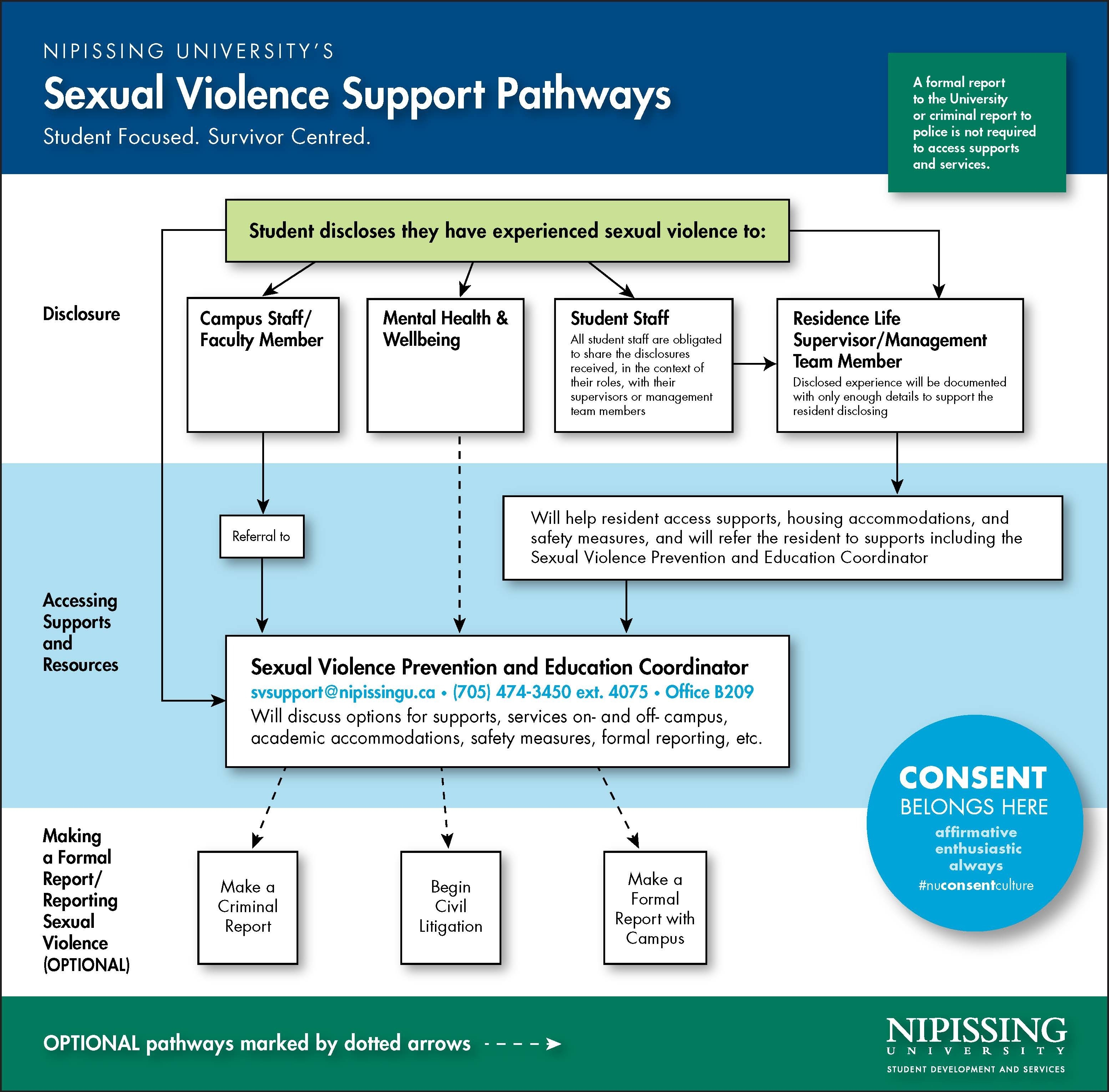
Nipissing University Sexual Violence Pathway Diagram Model

If you have experienced sexual violence or are supporting someone who has experienced sexual violence, the Sexual Violence Prevention and Education Coordinator is available to listen, support, and help you navigate the next steps in non-emergency situations.

If you are in immediate danger, contact 911.

Sexual Violence Prevention & Education Coordinator

Office: Student Development & Services, B209
Phone: 705-474-3450 ext. 4075
Email: svsupport@nipissingu.ca

The Sexual Violence Prevention and Education Coordinator is available to all Nipissing University students who may seek support or information related to sexual or gender-based violence. Additionally, the Sexual Violence Prevention and Education Coordinator is available to consult with and provide resources and support to those who have received a disclosure. 

What you can expect:

When connecting with the Sexual Violence Prevention and Education Coordinator, you can expect non-judgmental support for your disclosure and help to navigate the support options available, such as:

  • consider safety measures that may be necessary;
  • refers to medical services, as needed;
  • actively and empathically listen to their needs and concerns without judgment;
  • share reporting options available;
  • clarify commitments to confidentiality and its limits;
  • explain the difference between disclosure and reporting.
  • make a referral to the police if the individual chooses that option
  • assist with navigating any relevant University systems and procedures;
  • facilitate academic and/or residential accommodations;
  • provide information about and referral to campus and community services; and
  • liaise with relevant partners to ensure coordinated response and support.

Mental Health & Wellbeing

Mental Health & Wellbeing works to support all students in achieving positive mental and emotional wellness. 

Nipissing University Mental Health & Wellbeing

Office: B210
Phone: 705-474-3450 ext. 4507
E-mail: mhwellbeing@nipissingu.ca
Website: www.nipissingu.ca/mhwellbeing

Amelia Rising – Sexual Assault Centre of Nipissing

Amelia Rising Sexual Violence Support Centre provides free, completely confidential support for people 12 years of age and older who have experienced sexual or gender-based violence.

Amelia Rising – Sexual Assault Centre of Nipissing

101 Worthington St E., Suite 215 
North Bay, Ontario, Canada, P1B 1G5
Phone: 705-840-2403
Fax: 866-253-7476
Website: http://www.ameliarising.ca/

North Bay Regional Health Centre – Sexual Assault Treatment Centre

The Sexual Assault/Domestic Violence Program and Treatment Centre at NBRHC is an individualized service available to survivors of sexual assault, intimate partner violence. The program provides emergency health care and psychosocial support, and follow-up care by specially trained nurses.

North Bay Regional Health Centre – Sexual Assault Treatment Centre

50 College Drive
P.O. Box 2500
North Bay, ON
P1B 5A4
Phone: 705-474-8600 ext. 4478
Website: http://www.nbrhc.on.ca/programs-services/medical-services-2/sexual-assault-treatment-centre/

Helplines and Online Support

Good2Talk (Postsecondary Student Helpline): 1-866-925-5454

Victim Support Line: 1-888-579-2888

Mental Health Helpline (Health Services Information): 1-866-531-2600

Support Services for Male Survivors of Sexual Abuse: 1-866-887-0015

Assaulted Women’s Helpline: 1-866-863-0511

Talk4Healing (Aboriginal Women’s Helpline): 1-855-554-HEAL (4325)

Police Services

You may choose to report the sexual violence to the police. You may choose to do this whether or not you make a complaint with the University against the accused or not. Making a police report does not stop you from also making a complaint at the University against the accused.

The Sexual Violence Prevention and Education Coordinator is available to chat with you if you would like more information about either of these options or the next steps.

  • North Bay Police Service: 705-472-1234
  • 22 Wing Military Police: 705-494-2188
  • Anishinabek Police Service: 705-472-0270
  • West Nipissing Police Service: 705-753-1234
  • Ontario Provincial Police (OPP): 1-888-310-1122

Disclaimer

Please note that all external links and resources posted on the Consent Belongs Here website are not meant to replace face-to-face consultation with or diagnoses by qualified professionals, nor are they meant to be "online counselling." The listing of external sites does not imply that Nipissing University or its staff endorse all of the information located there. We cannot guarantee that all information on each site is accurate or complete. The resources and guidelines offered on this site are suggestions only, and do not substitute for consultation with a qualified Mental Health or Medical Professional.

By using these external links, you must agree to not hold the websites themselves, their staff or partners, or Nipissing University staff liable, or make any claims of damages of any kind, including claims of damages based on action taken by you related to the information contained on the respective websites.

Your use of these websites constitutes your agreement to the above terms.

Sexual violence is a traumatic experience. While every individual will react differently, the experience can have significant lasting effects and interrupt many aspects of a survivor's life. A supportive and non-judgemental initial response to disclosure can significantly impact the survivor's ability to seek further support.

If there is an imminent risk of harm:

In an emergency on campus (i.e., imminent threat of sexual violence and of harm to a person or sexual violence actually occurring) a call can be made 24 hours a day, 7 days a week and 365 days a year in the following ways:

  • Call 911
  • Call Campus Security 705-498-7244
  • Emergency phones, located inside the Education Centre near the elevators of the H and A wings. These phones are connected directly to Campus Security. All payphones have free access to 911.
  • Emergency phones, located outside the Education Centre and Residence buildings. The blue light can identify these phones and link a caller to an emergency answering service attendant. Simultaneously a call from these phones notifies Campus Security of the call and caller's location. 
  • In-person: Campus Security office, Education Centre B203
  • When a person discloses an incident of sexual violence to Campus Security, Campus Security will inform Student Development and Services that an incident has occurred. 

Sexual Violence Prevention & Education Coordinator

The Sexual Violence Prevention and Education Coordinator is available to all Nipissing University students who may seek support or information related to sexual or gender-based violence. Additionally, the Sexual Violence Prevention and Education Coordinator is available to consult with and provide resources and support to those who have received a disclosure. 

Office: Student Development & Services - B209
Email: svsupport@nipissingu.ca
Phone: 705-474-3450 ext. 4075

Consent Belongs Here is Nipissing University’s campaign to end sexual violence through education, prevention and outreach. The hashtag #nuconsentculture is included as a symbol to start a campus-wide conversation around preventing sexual violence. Consent Belongs: Here, events and initiatives on campus will be organized focused on sexual violence prevention and education throughout the year. 

Indicate your interest in participating in the upcoming training.  All sessions require a minimum of 5 participants.

2025-2026 Training Interest Form 

Are you looking for something a little different or personalized training? Email consentbelongshere@nipissingu.ca to let us know what you’d like.

Unmasking Masculinity: A Restorative Justice Conversation

What Are Restorative Justice Conversation Circles?

These circles are community discussions aimed at exploring gender-based violence. Together, we will build relationships, raise awareness, and discuss how we can prevent and respond to these issues within our campus community.

Attendance at all three sessions is required.

Dates & Time
Session One: Foundations — Exploring Masculinity & Identity
Friday, November 14, 2025, at 3:30 PM - 6 PM (location TBD)

Session Two: Pressures, Pain & Power — The Impact of Harmful Masculinity Norms 
Monday, November 17, 2025, at 3:30 PM - 6 PM (location TBD)

Session Three: Reimagining & Responsibility — Healthy Masculinity & Relationships
Wednesday, November 19, 2025, at 3:30 PM - 6 PM (location TBD)

Description
What does it mean to be a man—and who decides? Unmasking Masculinity is a three-part restorative justice conversation series that invites students of any gender into a safe and inclusive space to reflect, share, and reimagine what masculinity can look and feel like in today’s world. Through facilitated dialogue, storytelling, and collective reflection, participants will explore:
? The messages we’ve received about masculinity and how they shaped our identities
? The pressures and pain of harmful gender norms—and their impact on self and others
? How to build healthier relationships through vulnerability, consent, and emotional connection
? What it means to reclaim and redefine masculinity in a way that aligns with our values

This is not a lecture or a workshop. It’s a conversation grounded in restorative justice values—mutual respect, courage, and honesty—where everyone’s voice matters. Come as you are. Listen. Speak. Heal. Reimagine. Spots are limited. Register now to be part of this transformative experience.

Why Participate?

- Engage in meaningful conversations about gender-based violence  

- Learn about restorative justice and its impact  

- Build community and foster relationships  

- Contribute to positive change in our environment  

- RSD Approved!

Ready to join us?

Indicate your interest in participating by filling out this form. 

Sexual Violence Prevention & Response Certificates

  • Are you interested in learning how to build safer spaces for individuals impacted by gendered and sexual violence? The Sexual Violence Prevention & Education Outreach team offers a series of virtual and in-person workshops that focus on building our awareness and skills to respond to disclosures and build solidarity for survivors. 

Students who complete each of the following workshops will be eligible to receive a Sexual Violence Prevention Certificate

  • Consent+ 
  • Gender 101 
  • Intro to Allyship 

Students who complete the above workshops in addition to the following workshops will be eligible to receive the Advanced Sexual Violence Prevention & Response Certificate

  • BITB (Bringing in the Bystander) 
  • Responding to Disclosures: Sexual Violence Response Training for Students 

Request your certificate here

Workshop Descriptions

All Consent Belongs Here workshops are Record of Student Development (RSD) approved!

Consent+*  

Consent+ is an interactive training designed to deepen participants' understanding of consent, sexual violence, and the broader cultural and personal dynamics that influence these issues. Through presentations, discussions, and reflection activities, participants will explore the definition and essential elements of consent, recognize various forms of sexual violence, and understand the impact of these behaviours in educational and social environments. 

The training encourages critical reflection on personal beliefs related to gender, sexuality, and relationships while promoting empathy and accountability. Attendees will also learn about available support resources and develop strategies to foster a consent-centred culture in their communities. 

Length: 90 minutes 

Format:  Available in virtual, hybrid, or in-person formats using slides and interactive discussions. 

Suggested Audience: New and incoming students 

Key Learning Outcomes: 

  • Understand what constitutes consent and sexual violence. 
  • Recognize the prevalence and impacts of sexual violence.
  • Identify various types of sexual violence, including how power and coercion affect consent. 
  • Critically reflect on personal beliefs shaped by social norms and media. 
  • Learn about available support resources for survivors. 

RSD Competencies:  Ethical Practice, Decision Making, Social Responsibility 

Building Communities of Consent (NEW)*

The Building a Community of Consent workshop is designed to engage student leaders in building and promoting consent-driven communities. This interactive training encourages participants to critically examine the elements of consent, explore the principles of a consent culture, and reflect on the social barriers that hinder its development.

Through group discussions, brainstorming activities, and action planning, participants will explore the impacts of consent violations on communities, understand the role of sex positivity in consent culture, and develop practical strategies to integrate consent into their everyday leadership and interpersonal roles. 

Length: 60 minutes 

Format: In-person session 

Suggested Audience: Students in leadership positions 

Upper year students 

Key Learning Outcomes: 

  • Discuss the nine essential elements of consent. 
  • Define what a “community of consent” entails. 
  • Identify societal and cultural barriers to consent. 
  • Analyze the broader community impact of consent violations. 
  • Engage in action-oriented planning to promote consent in leadership roles. 
  • Model respectful behaviour and help foster inclusive environments. 

RSD Competencies: Social responsibility, commitment and accountability, inclusion 

Gender 101*

Gender 101 Training is an interactive, introductory session designed to deepen participants' understanding of gender and its connection to sexual and gender-based violence. This training is grounded in trauma-informed, equity-oriented approaches and incorporates both lived experience and data-driven insights to foster awareness, empathy, and action. 

Participants will explore foundational concepts such as what gender is, how gender-based violence manifests, and the systemic and societal factors that perpetuate it, particularly as they affect transgender and gender-diverse communities. Key Canadian statistics and studies are shared to highlight the disproportionate rates of violence and discrimination experienced by these groups. 

Length: 90 minutes 

Format: Available in virtual, hybrid, or in-person formats using slides and interactive discussions. 

Suggested Audience: New and incoming students 

Key Learning Outcomes: 

  • Define gender-related concepts, including the distinctions between sex, gender identity, and gender expression. 
  • Understand how gender norms contribute to sexual and gender-based violence. 
  • Identify the disproportionate impacts on transgender and gender-diverse individuals using Canadian data. 
  • Recognize and challenge harmful stereotypes in media, language, and daily life. 
  • Explore how safety and inclusion vary by gender identity. 
  • Practice respectful behaviours such as using correct pronouns and intervening in discrimination. 
  • Commit to ongoing learning and advocacy in support of gender equity.

RSD Competencies: Equity and diversity, inclusion, social responsibility 

Bringing in the Bystander*

The Bringing in the Bystander workshop focuses on building awareness, responsibility, and action towards preventing interpersonal violence. This workshop prepares participants to recognize the continuum of sexual violence and learn strategies for safe and appropriate bystander interventions. Bringing in the Bystander will include discussions of sexual violence, rape culture, and encourage participants to reflect on their own roles as bystanders. This workshop may evoke strong emotions in some participants. 

Length: 2.5 hours 

Format: In-person  

Suggested Audiences: Students in leadership positions, Upper year students, Staff and faculty 

Key Learning Outcomes: 

  • Feel confident taking action when witnessing harmful behaviour. 
  • Understand how bystander behaviour influences community safety. 
  • Recognize problematic behaviours that may contribute to violence. 
  • Gain practical strategies for intervening safely. 
  • Challenge behaviours that reinforce rape culture. 
  • Reflect on the impact of normalized traditions and dynamics. 
  • Promote respectful behaviours in peer groups and campus culture. 

RSD Competencies: Empathy, Conflict Negotiation, Social Responsibility 

Intro to Allyship*

Intro to Allyship is a foundational workshop designed to engage participants in understanding and practicing allyship in the context of gender-based and sexual violence. Through interactive activities, data-informed insights, and reflective discussions, participants will explore the roots of sexual violence, the impact of power and privilege, and the role of allyship in fostering safer, more inclusive campus communities. 

This training emphasizes self-care, empathy, and community accountability. It is part of Nipissing University’s broader commitment to equity, consent education, and ending gender-based violence on campus. 

Format:  Available in virtual, hybrid, or in-person formats using slides and interactive discussions. 

Length: 90 minutes 

Suggested Audience: New and incoming students, Students in leadership positions 

Key Learning Outcomes: 

  • Understand how sexual violence disproportionately affects marginalized groups, including LGBTQ2S+ individuals, Indigenous people, and students with disabilities. 
  • Reflect on personal identity and privilege using the Power and Privilege Wheel. 
  • Learn actionable allyship strategies, including support, intervention, and accountability. 
  • Practice meaningful apologies and address harm with care. 
  • Identify personal steps along the Allyship Continuum from apathy to advocacy. 

RSD Competencies:  Empathy, Equity and Diversity, and Inclusion

Sexual Violence Response Training - Students*

Sexual Violence Response training is designed to enhance understanding of sexual violence and its community impact. Participants will learn to recognize various forms of unwanted sexual behaviours and explore the psychological, social, and emotional effects on survivors. The training focuses on developing skills for providing supportive responses to disclosures while addressing confidentiality issues. By the end, attendees will be equipped to handle disclosures of sexual violence with confidence, empathy, and respect. 

Length: 2 hours 

Format: Available in virtual, hybrid, or in-person formats using slides and interactive discussions. 

Suggested Audiences: Students in leadership positions, Upper year students, Staff and faculty 

Key Learning Outcomes: 

  • Define sexual violence as an umbrella term for various unwanted sexual behaviours. 
  • Increase awareness of the emotional, social, and psychological impacts on survivors. 
  • Build confidence and skills to respond to disclosures with empathy and care. 
  • Know how and when to seek help for oneself or others. 
  • Navigate confidentiality responsibly, understanding when information can be shared. 

RSD Competencies: Empathy, Critical Thinking, Inclusion, Emotional and Interpersonal Intelligence, Leadership 

Below are links to websites and resources. Please note, we do not own/maintain the information on these external links. These resources are available in print format from the Sexual Violence Prevention & Education Coordinator in office B209.

Looking for more information? Contact the Sexual Violence Prevention & Education Coordinator:
Office: Student Development & Services - B209
Phone: 705-474-3450 ext. 4075
Email: svsupport@nipissingu.ca

Healthy Relationships

Sex Positive Resources

Human Rights & Consent Law

Sexual Violence

Consent

Sex, Gender and Sexual Orientation

Safer Partying

Harm Reduction/Safer Partying Tips

Below is information on have a safer and fun night when consuming alcohol

  • Stick with a group and watch out for each other. Plan to arrive together and leave together. If you decide to leave early, let your friends know that you’re leaving and when you arrive home safely. 
  • Keep your phone charged. Stay in contact with your group, use it to ger home, and in case of an emergency.
  • Plan a safe way home. Have a sober friend available to drive, or plan your trip home with a taxi, Uride, or bus.
  • Know what you’re drinking. Don’t recognize an ingredient? Use your phone to look it up. Consider avoiding large-batch drinks like punches that may have a deceptively high alcohol content and may have other ingredients added. If you choose to drink from a communal mix, let a friend know, take a slowly and listen to your body.
  • Trust your instincts. If you feel unsafe, uncomfortable, or worried for any reason, don’t ignore these feelings. Go with your gut. Get somewhere safe and find someone you trust, or call Campus Security or the Police.
  • Don’t leave a drink unattended. That includes when you use the bathroom, go dancing, or leave to make a phone call. Either take the drink with you, have a trusted friend hold it or throw it out. Avoid using the same cup to refill your drink.
  • Be aware. Pay attention to your drink and what is going on around you.
  • Consume with consent. Make sure everyone consents to each round and let everyone order and pick up their own drink.
  • Check-in with yourself. You might have heard the expression, “know your limits.” Whether you drink regularly or not, check in with yourself periodically to register how you feel. If you think you have had too much, ask a staff member to help you get water or get home safely.
  • Be aware of sudden changes in the way your body feels. You might have heard the expression, “know your limits.” Whether you drink regularly or not, check in with yourself periodically to register how you feel. If you think you have had too much, ask a staff member to help you get water or get home safely.
  • Get help. If something doesn’t look right, step in. Don’t be afraid to let a friend know if you are uncomfortable or worried about their safety.
  • Have a snack. Balance out alcohol consumption with drinking water and eating between drinks.
  • If you are planning on consuming a lot, ensure you are with a friend in a safe place, and stick to one substance at a time.

Safer Drinking

Canada's Low-Risk Alcohol Drinking Guidelines can help you make informed decisions about drinking.

  • Drink slowly. Aim for a maximum of 2 standard drinks in any 3 hours.
  • For every drink of alcohol, have one non-alcoholic drink. 
  • Consider your age, body weight and health when setting your limits. 

A standard drink is a measure of how much pure alcohol you are drinking. It varies based on the concentration of alcohol in a beverage.

In Canada, a standard drink is 17.05 millilitres or 13.45 grams of pure alcohol. This is the equivalent of:

  • a bottle of beer (12 oz., 341 ml, 5% alcohol)
  • a bottle of cider (12 oz., 341 ml, 5% alcohol)
  • a glass of wine (5 oz., 142 ml, 12% alcohol)
  • a shot glass of spirits (1.5 oz., 43 ml, 40% alcohol)
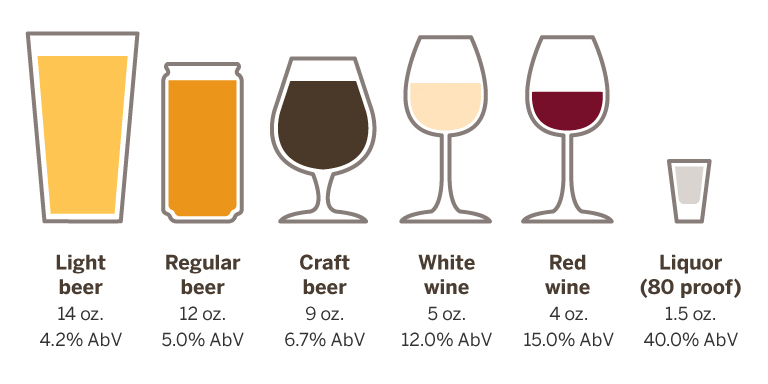
Shows amount of alcohol per standard drink


Image source: https://alcohol.iupui.edu/calculators/alcohol-serving-size.html

Drink Calculator


Drink Spiking

Any substance that alters ones level of consciousness and / or physical ability to resist or fight back can be used to commit Drug-Facilitated Sexual Assault. Causing someone to ingest something without their awareness is called ‘drink-spiking’, ‘spiking,’ or non-consensual dosing. Alcohol is the most common substance used to facilitate DFSA.

DFSA occurs when alcohol or other substances are used to intentionally sedate or incapacitate a person in order to perpetrate sexual assault. DFSA also makes a person more vulnerable to human trafficking, robbery, abduction and injury.

Most often, the assumption of how DFSA occurs is when a perpetrator puts a drug into an unsuspecting victim’s drink. This is considered a ‘proactive’ DFSA. 

A ‘proactive’ DFSA also includes supplying someone with large quantities of alcohol with the intent to incapacitate them.

An ‘opportunistic’ DFSA occurs when someone specifically targets an already intoxicated person. 

Redflags

Redflags to watch out for when it comes to drink-spiking when someone is:

  • Making 'jokes' or comments about getting people drunk in order to have sex with them.
  • Pressuring others to drink faster, larger quantities, or stronger drinks.
  • Targeting the most visibly intoxicated person in the space.
  • Making or ordering drinks stronger than asked for.
  • Trying to get an incapacitated person alone / away from friends, or outside of the space.
  • Purchasing drinks for others with a sense of entitlement to attention or physicality in return.
  • Pressuring people to do drugs.
  • Flirting with people who are in need of care or support due to over intoxication.

(source: goodnightoutvancouver.com)

Signs and symptoms

Signs and symptoms that can accompany non-consensual dosing:

  • Slurred Speech
  • Dizziness
  • Drowsiness
  • Headache
  • Passing out
  • Vomiting
  • Alert & aware but unable to move
  • Someone saying something like "I shouldn't be this drunk" or "I've only had one drink."
  • Missing parts or all of the evening
  • Hangover doesn’t match amount drank
  • Indicators of sexual assault
  • conciseness (blacking out)
  • Loss of memory

(source: goodnightoutvancouver.com)

If you have been a victim of drink spiking or non-consensual dosing, it is not your fault. Please see our Getting Help tab.

REES (Respect, Education, Empower, Survivors)


In partnership with the Nipissing University Student Union (NUSU), Nipissing University has joined with REES (Respect, Educate, Empower Survivors) to provide online reporting for sexual violence on campus. REES allows campus community members to Create a Record of the incident and choose from multiple reporting options: Anonymous Report, Connect to My Campus, or Repeat Perpetrator Identification (RPI). REES provides information about campus and community-based resources such as sexual assault centres, healthcare, and support services.

REES is available https://www.reescommunity.com/campus/

About your Reporting Options with REES:

Create a Record

  • You can Create a Record without choosing a reporting option. Your Record will be securely stored in REES until you are ready to report.
  • Records stored in REES cannot be accessed by REES or Nipissing University Only you can access your Record unless you choose to send it as a Connect to My Campus.

Anonymous Report

  • An Anonymous Report allows an individual to share information about an incident of sexual harassment, misconduct or assault without identifying themselves, or identifying the person who has harmed them.
  • Anonymous Reports will include only the multiple-choice questions and gender questions from your Record. Anonymous Report data will be provided by REES to Nipissing University to measure the incidence and identify patterns of sexual violence on campus, with the goal of improving policy, supports or responses to sexual violence on campus.
  • Because an Anonymous Report does not include any identifying information about the persons involved, it cannot initiate an investigation, and Nipissing University does not have the ability to follow up with you directly.

Connect to My Campus

  • Connect to My Campus allows you to reach out to Sexual Violence Prevention & Education. You can receive support, resources, and information, or discuss the formal complaint process.
  • There is no time limit to Connect to My Campus.

Repeat Perpetrator Identification (RPI)

  • Repeat Perpetrator Identification (RPI) is a feature of REES that helps to identify a person whose behaviour has harmed multiple people.
  • You provide identifying information about the person that is stored in a database. If more than one individual identifies the same person has harmed them, a match is made and Nipissing University is notified.

Lakers Athletics

Sexual Violence Prevention Education Module for Athletics

The following module contains important information about the services available and how to seek support for yourself or your teammates in case of experiencing or witnessing sexual violence.

All first-year athletes must complete this training. The module takes 30-40 minutes to complete and can be done on your personal device.

Click here to launch the Sexual Violence Prevention Education Module for Athletics

Opt-Out Option

We understand that everyone has different experiences with sexual violence. If you can't do this module now because of its content, you can opt-out after logging in and seeing the support services available.

Lakers Athletics Sexual Violence Prevention & Education Handbook

This handbook was developed alongside the Sexual Violence Prevention & Education Module created for Lakers Athletics. It includes resources and supports available within the University and the wider North Bay community. Descriptions are provided to summarize the supports and services provided by each listed service.

Remember, navigating support services can be confusing. If you are unsure where to go or whom to contact, the SVPE Coordinator can help answer questions and connect you with the support you are interested in.

Our services are available to all members of the Lakers community, including undergraduate, graduate, and continuing education students, staff, and faculty.

In-person:

Student Development and Services, B209

General Inquiries:

Phone: 705-474-3450 ext 4075
Email: svsupport@nipissingu.ca

Training and Workshop Inquires:

Phone: 705-474-3450 ext 4075
Email: consentbelongshere@nipissingu.ca