-
 Learn more
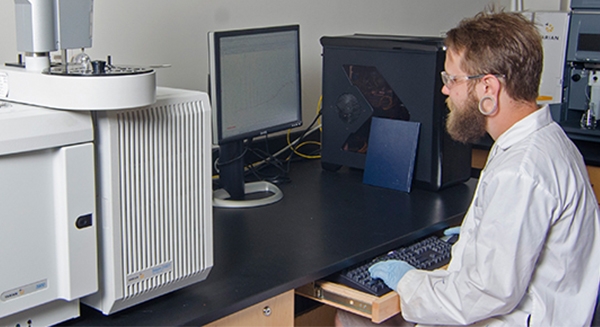
The Nipissing University Research on Neuroscience (NURON) lab at Nipissing University houses a range of specialized brain tissue preparation and microscopic equipment. These include a transmission electron microscope (TEM), a confocal laser microscope, and specialized light microscopes with digital cameras. Tissue preparation equipment includes a Leica cryostat for frozen brain sectioning and an ultramicrotome for thin sectioning of resin embedded tissue (nanometer scale). Together, this suite of equipment allows for the full exploration of ultrastructural brain changes associated with neural plasticity and neurodegenerative disease.
Contact:
Amy Stillar
705-474-3450 ext. 4486
amys@nipissingu.ca -
Plant Ecology Research Laboratory
Learn moreThe Plant Ecology Research Lab (PERL) investigates the ecological processes that regulate forest regeneration and long-term ecosystem resilience. Our research examines how physical and biotic stressors interact to constrain or redirect forest renewal across temperate and boreal landscapes. A central focus is understanding how chronic disturbance alters growth trajectories, resource allocation, and survival of tree seedlings and saplings. By integrating field experiments, chemical analyses, dendrochronology, and stand-level assessments, PERL seeks to identify the mechanisms that determine whether forests recover, transform, or experience persistent regeneration bottlenecks.
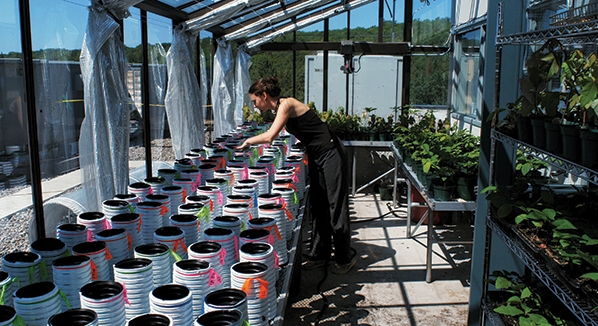
PERL research is supported by laboratory and greenhouse facilities at Nipissing University. Researchers have access to programmable greenhouse environments that allow controlled manipulation of light, temperature, and moisture regimes for seedling experiments. PERL is equipped to measure growth responses to disturbance across all stages of tree development, from controlled seedling trials to field-based assessments of saplings and mature trees. PERL researchers use the Central Analytical Facility for chemical and structural analyses of water, soil, and plant tissues, including preparation and processing of samples for plant secondary metabolites, fiber chemistry, nutrient assays, and related ecological measurements. These resources enable integration of controlled experiments with field-based studies across multiple spatial and environmental scales.
Contact:
Peter Nosko
705-474-3450 ext. 4323
petern@nipissingu.ca -
Plant Signal Transduction
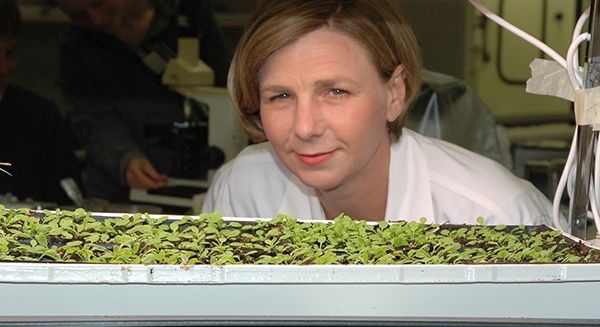
Learn moreDr. Cholewa studies plant structure and function. Her research interests are reflected in numerous collaborative publications, from vein arrangement and water transport in plants from Costa Rica’s rain forest to the ion and photoassimilate transport in arctic sedge. Dr Cholewa's research at Nipissing University is based on the application of a Confocal Laser Scanning Microscope in studies of signal transduction pathways in plants, allow the examinaton of responses to the environmental and chemical signals at the cellular and subcellular levels.
-
Rare Dementia Support (RDS) Canada
Room: A230
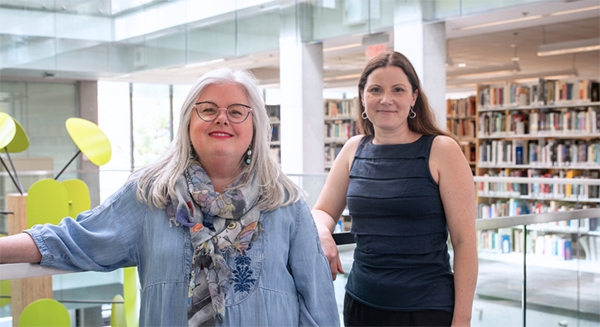
Learn moreRDS Canada provides a virtual space for anyone affected by a rare dementia offering access to information, tailored individual and group support and guidance, and connection with others who are affected by similar conditions. The team includes dementia care practitioner specialists, researchers, educators and individuals with lived experience through our Advisory Group. RDS Canada is committed to ongoing research about best practices in the provision of support for people living with or caring for someone with rare dementia. Our learning is mobilized through the delivery of RDS Canada, presentations to lay and academic audiences, education and the development of resources for people living with dementia and practitioners.
-

Research Data Centre (RDC)
Room A151
Learn moreResearch Data Centres (RDCs) are secure facilities within the Canadian Research Data Centre Network (CRDCN) that provide researchers access to Statistics Canada microdata. Operated by Statistics Canada employees under the Statistics Act, RDCs ensure data confidentiality and require researchers to obtain security clearance, become ‘deemed employees,’ and follow strict confidentiality guidelines.
As part of a national initiative by Statistics Canada, SSHRC, CIHR, and university partners, RDCs support research across Canada, offering professors, graduate students, and external researchers access to confidential data for theses, reports, and publications.
-
Sensory-Movement Behaviour Lab
Room: AC206
Learn moreResearchers in the Sensory-Movement Behaviour Lab examine how typically developing people and those compromised by disorders, disease, or trauma control their movements. The goal of the lab is to identify human capacities and reduce barriers with the intention of increasing the quality of life of all Canadians.
Optotrak Certus 3D Motion Capture System (Northern Digital Inc.; CFI funded)
The Optotrak Certus is a research-grade active marker motion capture system that is often referred to as the gold standard among research scientists. In 3D mode, the Optotrak Certus system has an accuracy of 0.1 mm, a resolution of 0.01 mm, and a max sampling rate of 4600 Hz. In addition, the Optotrak Certus system allows for the real-time synchronization and integration of third party equipment such as eye-trackers, EMG, and force plates. Northern Digital Incorporated is a Canadian manufacturer and developer of industry leading research-grade motion capture systems.Eyelink 1000 Binocular Eye-tracker (S-R Research; CFI funded)
The Eyelink 1000 system is a binocular eye tracker with a high spatial accuracy (0.25-0.5 degrees), high resolution for eye-tracking (0.01 degrees) and micro-saccade identification (0.05 degrees), has a low noise signal (0.05 degrees), and has a high binocular data collection rate in both the head supported (1000 Hz) and remote settings (500 Hz), and features rapid set-up and calibration processes. SR-Research is a Canadian-based international company who manufacture field leading research grade eye-tracking equipment.Bagnoli 16 Channel EMG System (Delsys; CFI funded)
The Delsys Bagnoli 16 channel EMG system with software, trigger module, skin interfaces, and reference electrodes. The EMG system measures the muscle activity of 16 muscles during human movement. The unit can sample from multiple other biosensors such as potentiometers, accelerometers, and load cells.Digitizing Tablet (Wacom)
The Wacom digitizing tablet (Intuos4 XL) allows the participant to use either a pen or mouse on a large aiming surface (46×30 cm) while we record their movements in 2D. During experiments, we can learn much about how people plan and execute their movements from these recordings.Liquid Crystal Goggles (Translucent Technologies)
The P.L.A.T.O. liquid crystal goggles are used to control the timing of the presentation of the visual environment to the experimental participant. The goggles can open within 4 ms and close within 3 ms. The lenses are clear when open and appear translucent, or milky white when closed. -
Social Neuroendocrinology Laboratory
Room: A223
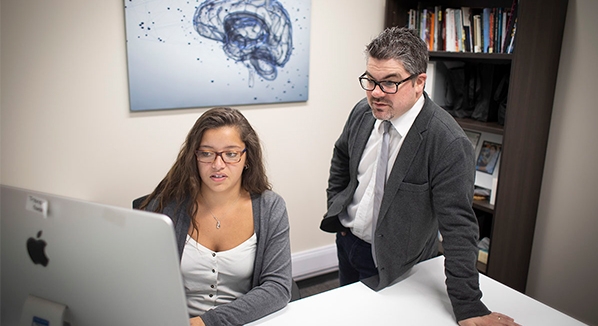
Learn moreThe Social Neuroendocrinology Lab takes a social neuroscience approach to research by combining theory and methodology from social and experimental psychology, endocrinology, neuroscience, social cognition, pharmacology, and molecular genetics. Their ultimate goal is to detail the complex mechanisms underlying variation in human competitive and aggressive behaviour. Their new 1,500 square foot lab facility, which opened in 2017, allows for more on-site testing.
-
Watershed Hydrology Laboratory
Rooms: R219-R222
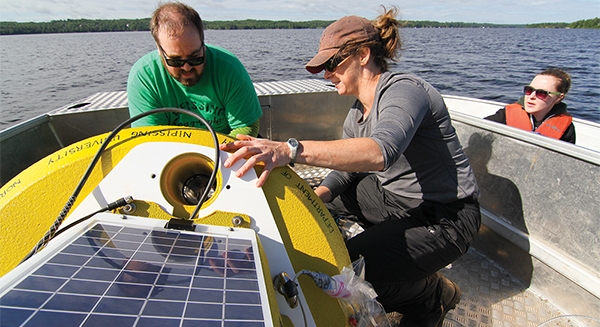
Learn moreThis laboratory supports catchment hydrology, lake and weather monitoring, and computer modelling. Field equipment supports the study of hydrologic processes (e.g. streamflow generation) under varying environmental conditions and includes meteorological stations, streamflow monitoring station packages (Isco auto-sampler, raingage, pressure transducer, YSI EC/Temperature probes), groundwater recording (water level meters, capacitance rods) and sampling instrumentation (peristaltic pump, drive-point piezometers), soil moisture monitoring probes and lysimeters, basic hydrometric equipment (pygmy meter outfit with Aquacalc 5000, constant head permeameter, soil auger kit) and a field truck. Field and lab equipment supports use of a range of environmental tracers of water movement and sources within the landscape (temperature, EC, stable isotopes of 18O/16O, and D/H).
Computer stations support data analysis, catchment modelling and spatial analysis (i.e. GIS). A rugged field notebook supports field-based downloading and programming capabilities.
Lake profile monitoring equipment includes two Fondriest CB-405S Data Buoys equipped with thermistor chains, EXO2 Sonde and sensors (EC, T, pH, total algae, turbidity), data loggers, and weather instrumentation (wind speed/direction, RH, rain).
This laboratory analyses water samples (liquid and vapour) for stable isotope ratios of 18O/16O, and D/H using a L2120-i Picarro isotope liquid water analyser. Equipped with a Millipore DI water purification system and cold storage (fridge, freezer), the lab also supports preparation and storage of water samples for additional off-site analyses (e.g. cation, anion, trace element, TOC).
Computer stations support data analysis, catchment modelling and spatial analysis (i.e. GIS). A rugged field notebook supports field-based downloading and programming capabilities.
Contact
Dr. April James
705-474-3450 (X4062)
aprilj@nipissingu.ca. -
Wildlife Ecology and Environmental Science Lab
Learn moreIn our lab:
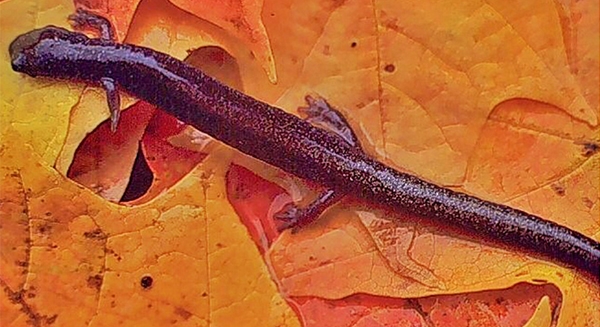
we assess the health and vitality of wildlife species such as wolves, loons, martens, fishers, salamanders, and frogs;
we delve into factors that may be affecting wildlife, such as pollutants, herbicides, pharmaceuticals, car collisions, and climate change;
we work with partners such as the Ontario Ministry of Natural Resources and Forestry, and the Fur Harvesters’ Auction, to investigate wildlife issues; and
we produce a textbook on Environmental Science, every 3 years, that is used at Canadian Universities from coast to coast.