Research Centres

The best research is collaborative.

Read on to learn more about the interdisciplinary research taking place in our Research Centres. Or check out some of the laboratories and cutting-edge research facilities where research happens at Nipissing.

  • northern Ontario lake stock image

    Alcan Field Station

    Lake Talon

    Learn more

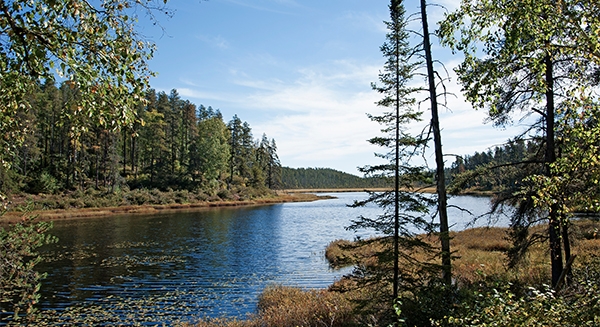
    The Nipissing University-Alcan Environmental Research Preserve (NUAERP) consists of over 3 km2 of wilderness land located approximately 45 km east of North Bay. The property was donated to Nipissing University by Alcan Canada in 1999 with the condition that the land remain in a pristine state and that it be used for environmental research.

    The property encompasses a range of aquatic, wetland and terrestrial environments including coniferous and deciduous forests representative of the Great Lakes - St. Lawrence Forest Region. The property is bounded by Lake Talon to the southwest and offers shoreline access to a number of smaller lakes. The range of terrestrial and aquatic environments makes the NUAERP a unique and valuable resource for research and teaching activities in the environmental sciences. This undeveloped property is relatively inaccessible and, together with the surrounding crown land, forms a controlled watershed making it an ideal situation for long-term environmental research.

    Two skidoos, several boats and a cottage are available at the station.

  • Analytical and Environmental Chemistry lab

    Analytical and Environmental Chemistry


    Learn more

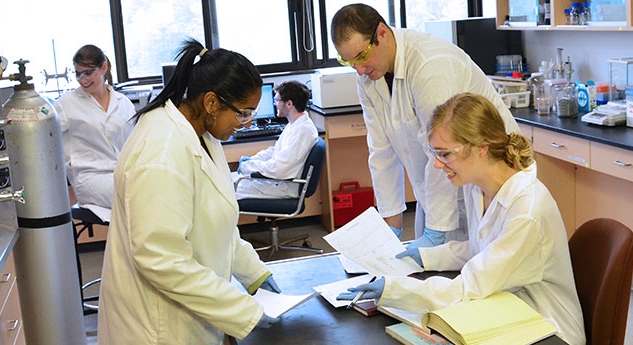
    Dr. Kariuki's current interests include hydrometallurgy as well as a study of the effects of reduced sulphur species on water quality. The main goal of the hydrometallurgical research that we are performing is to develop more environmentally friendly and economical ways of mining minerals compared to the smelting processes that have traditionally been used.

    An important part of the sulfur project is an investigation of the speciation of the reduced sulfur species in drinking water sources.

    The above research is being carried out using a variety of techniques that include Atomic Absorption Spectroscopy (AAS), High Performance Liquid Chromatography (HPLC), and Voltametric techniques. 

  • Biomechanics Lab

    Biomechanics and Ergonomics Laboratory

    Room: AC148

    Learn more

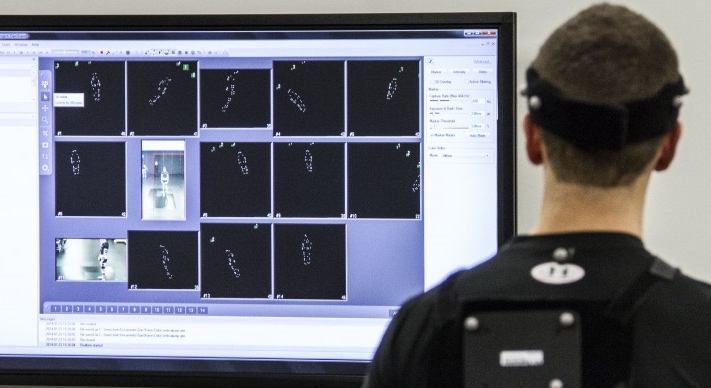
    The Biomechanics and Ergonomics Lab is located within the Centre for Physical and Health Education. The lab contains a full suite of hardware and software to facilitate the quantification of human movement and its underlying causes, with the goals of improving performance and/or reducing injury risk. The space features a large primary motion capture space, surrounded by a ceiling-mounted camera bar and centred around a custom force plate grid; neuromuscular testing equipment; ultrasound scanning capabilities; and standard software packages for biomechanical data collection, processing, and analysis (e.g., Visual3D, Matlab, Labview, Python).

    Contact:

    Dr. Dean Hay, Professor/Director, SPHE 
    705-474-3450 x4585 
    deanh@nipissingu.ca OR directorsphe@nipissingu.ca

    Dr. Aaron Kociolek, Associate Professor 
    705-474-3450 x4211 
    aaronk@nipissingu.ca

    Dr. Alison Schinkel-Ivy, Associate Professor 
    705-474-3450 x4561 
    alisons@nipissingu.ca

  • Central Analytical Facility equipment

    Central Analytical Facility

    Room: R109

    Learn More

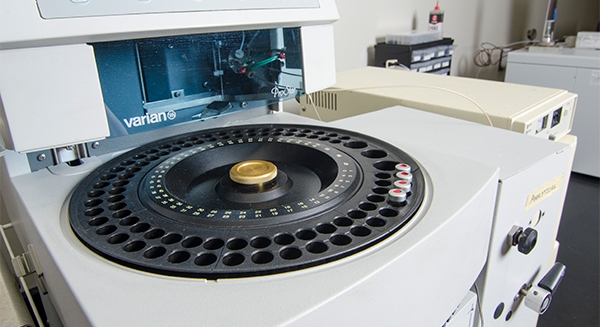
    The Central Analytical Facility (CAF) at Nipissing University houses a wide range of analytical instrumentation, including an Agilent LC/GC‑QTOF, Tekran 2600 and 2700, a BioTek plate reader, a Thermo ICS 3000, a Bruker NMR, and an FTIR. The facility is also equipped with essential laboratory tools for sample preparation, such as ultra pure water system, filtration systems, incubators, ovens, balances, centrifuges and extractors.

    Contact

    Ashley Marcellus
    705-474-3450 ex. 4705
    ashleym@nipissingu.ca

  • interior of Elizabeth Thorn Centre

    Centre for Literacy - Elizabeth Thorn

    Room: R227

    Learn more

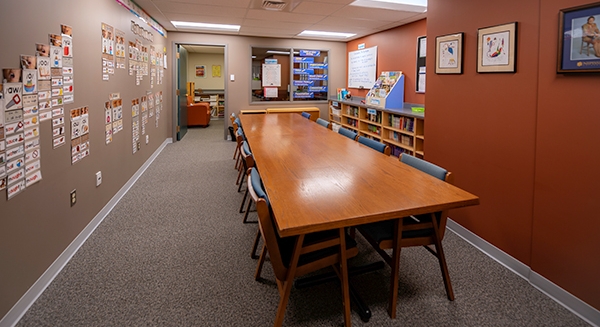
    The Dr. Elizabeth Thorn Literacy Centre is a campus space for Education Students – Concurrent and Consecutive! A space for learning, studying, meeting as small groups, collaborating, and more!

  • C-WAG space with 3 students doing work and reading books inside

    Centre for the Study of War, Atrocity, and Genocide

    Room: A242

    Learn more

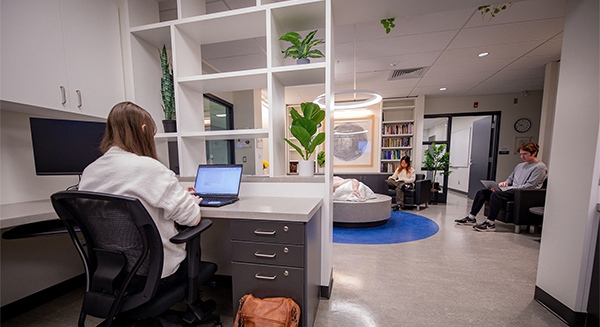
    Researchers at the Centre for the Study of War, Atrocity, and Genocide (C-WAG) engage with important questions about state-sponsored violence, including the structural violence and displacement that accompanies colonial practices, war, and genocide and the role that transitional and retributive justice play in the reconstruction of post-conflict and post-colonial societies. Community researcher partners, affiliates, and Nipissing University students are also an integral part of the Centre's research practices and ethic. As a place of knowledge production, methodological innovation and training, the Centre makes academic research on genocide and state violence accessible to the wider Nipissing University and North Bay communities as well as to other sectors of society.

  • Collaborative Systems Laboratory students with professor

    Collaborative Systems Laboratory

    (CoSys Lab)

    Room: R230

    Learn more

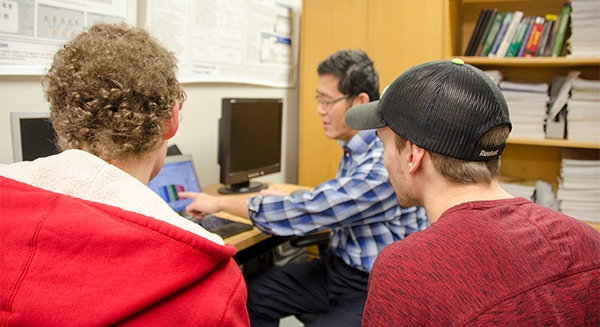
    Current research in the CoSys Lab is focused on Collaboration Theory, Technologies, Systems, and Applications (Role-Based Collaboration and Adaptive Collaboration), Human-Machine Systems, CSCW (Computer-Supported Cooperative Work), Multi-Agent Systems, Software Engineering, and Distributed Intelligent Systems.​

  • Drosophilia Laboratory

    Drosophilia Laboratory - Genetics and Aging

    Room: R217

    Learn more

    The primary research interests of the Genetics and Ageing Lab involve the genetics and molecular biology of oxygen free radicals, toxic forms of oxygen generated as a byproduct of normal cellular metabolism, and how they affect ageing. Oxygen free radicals are unstable molecules that can react quickly with other atoms and molecules, causing damage to living tissues. It is the accumulation of such damage that is believed to be the root cause of the ageing process and lead to specific age-related diseases as well as general functional decline.

    Assistant Professor of Biology, Dr. Tony Parkes

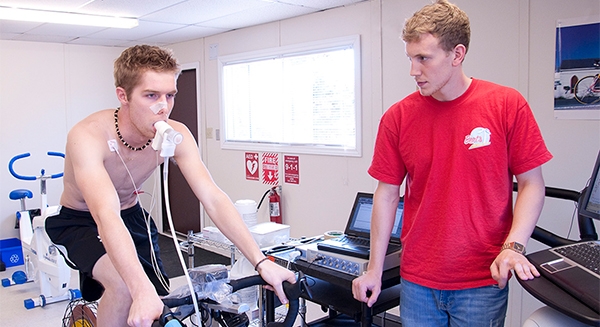
  • Young shirtless man wearing sensors pedaling a cycle ergometer while a lab technician in a red shirt monitors data

    Exercise Physiology Laboratory

    Room: AC152

    Learn more

    Research infrastructure includes a temperature-, humidity-, and oxygen-controlled environmental chamber, a dual-belt instrumented treadmill, motion-capture system, metabolic carts, velotron cycle ergometers, near-infrared spectroscopy, electromyography, and blood sampling equipment.

    Contact:

    Graydon Raymer or geoffh@nipissingu.ca

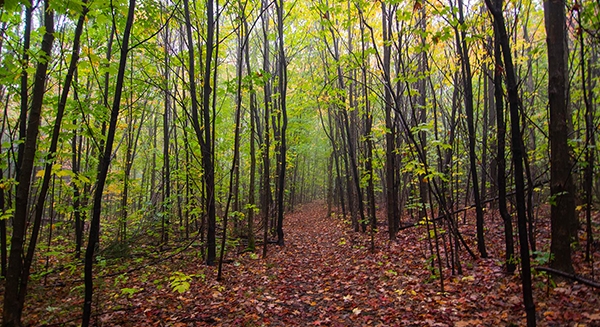
  • Campus trails

    Forest Resources Laboratory (FRL)


    Learn more

    Research in the Forest Resources Laboratory (FRL) at Nipissing University focuses on aspects of biology at the community, ecosystem and landscape levels of organization. Using the forests of the Great Lakes - St. Lawrence and Northeastern Boreal regions of Ontario as our natural laboratory, we explore patterns in the distribution, composition and productivity of plant communities, and the ecological drivers that produce these patterns. Ultimately, we strive to translate the knowledge we gain of ecological patterns on the landscape in to practical applications for forest resource management.

    A major aim in our research is providing scientific knowledge to support the sustainable development of new forestry products in northern Ontario. Recently we have embarked on a long-term research program with the objective of developing ecological inventory and supply-management tools for Boreal forest resources. These resources include both the forest trees (sources of fibre, biomass and biofuels) and the understorey plants (sources of pharmaceuticals, nutraceuticals and foods). Species of interest include Black Spruce (Picea mariana), an important Boreal forest tree, and Ground Hemlock (Taxus canadensis), an evergreen shrub that is a source of paclitaxel, which is used in the treatment of various types of cancer. This list is expanding as the project develops, adding as many plant species as possible to the inventory.

    Studies currently underway in the FRL are aimed at developing models of abundance, productivity and quality for each species of interest across the range of ecological conditions which occur in the Boreal forest. To reach this goal we use dendrochronology, digital image analysis, ecological land classification, geographic information systems and predictive ecological mapping techniques.

    For more information on the FRL or any of our projects please contact Dr. Jeff Dech.