Ananya Singh describes her time at Nipissing University as transformative, both academically and personally.
As a Master of Arts student in Sociology, her interest in social research has become a defining part of her identity. This includes analyzing restricted Statistics Canada microdata through the Research Data Centre (RDC) and contributing to a variety of qualitative and quantitative research initiatives. Working under the guidance of Dr. Amir Erfani, Professor of Sociology at Nipissing University, Ananya has learned to think more rigorously, defend her methodological choices, and grow comfortable with the back-and-forth of academic critique.
“Beyond the technical skills, Nipissing gave me a strong sense of what it means to be a researcher – patient, precise, and willing to revise your thinking when the evidence calls for it,” shared Ananya. “I’m graduating a more confident, resilient, and intellectually curious person than when I started.”
During her time at Nipissing, Ananya has explored a variety of research topics ranging from how gender equality and the division of household tasks shape fertility decisions to understanding youth mental health outcomes.
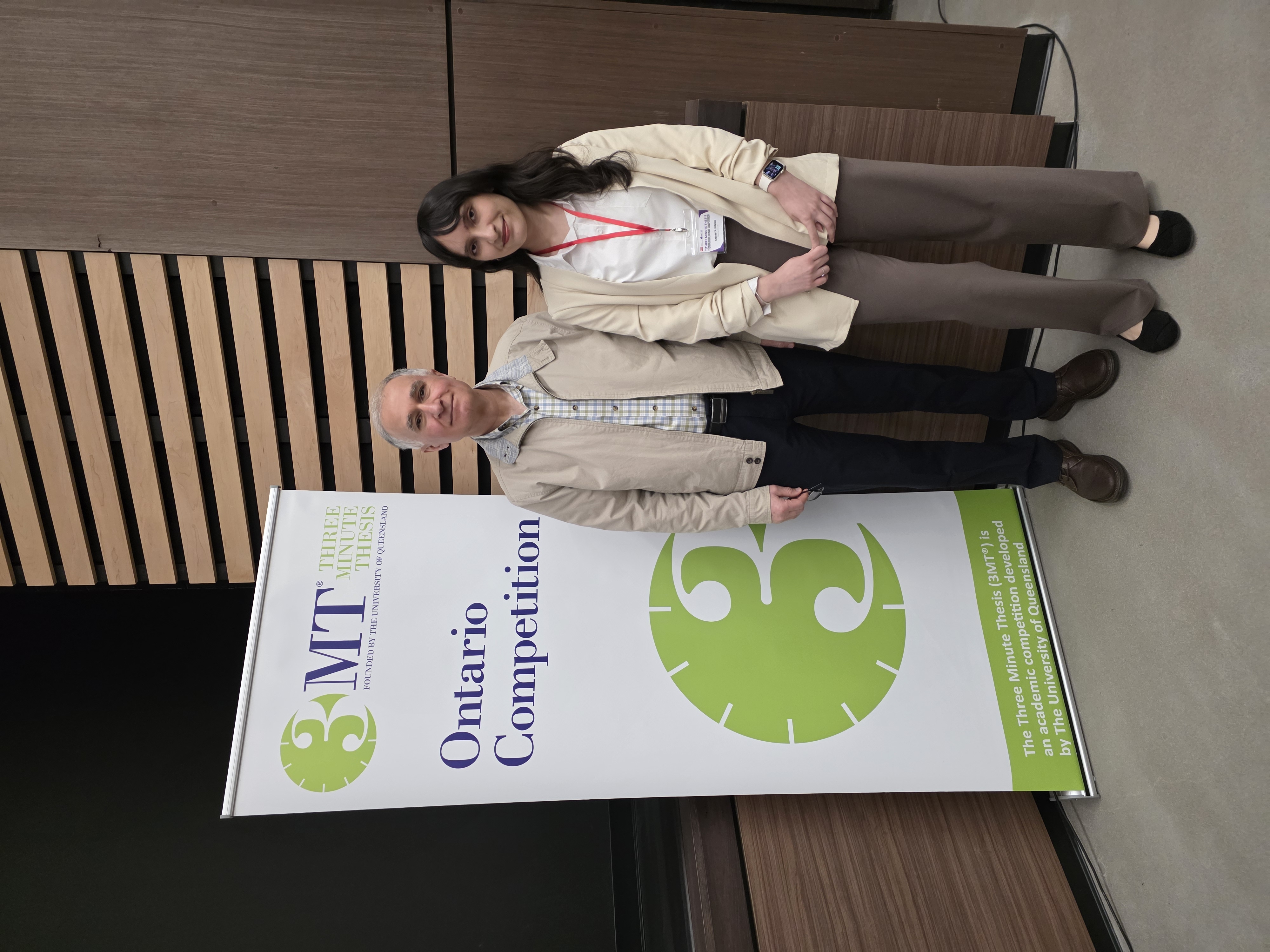
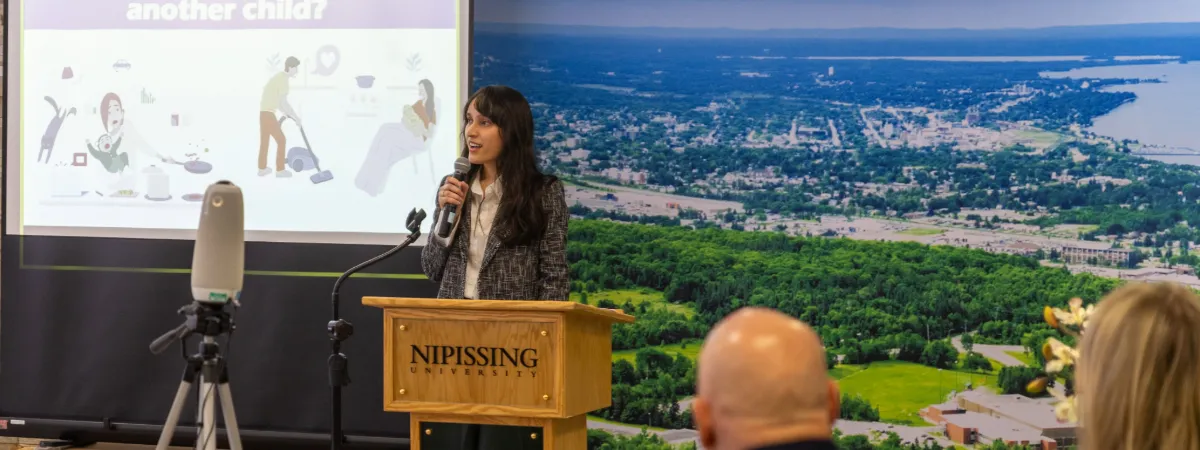
This spring, Ananya presented her research entitled “Gender Equality & Equity in Household and Childcare Tasks and Fertility Intentions in Canada”, at Nipissing University’s annual Three Minute Thesis (3MT®) Competition where she was awarded first place. Her research used microdata from the Survey on Family Transactions (SFT, 2024) to examine how the division of household and childcare tasks influences fertility intentions and intended number of children among partnered Canadians aged 20 to 39. As Canada's total fertility rate reached 1.25 children per woman in 2024, the study's findings are expected to inform Canadian family policies supporting work-family balance and shared parenting responsibilities. Ananya went on to represent Nipissing University at the 3MT® Regional Competition at Brock University.
Additionally, Ananya’s research entitled “Everyday Discrimination, Bullying and Youth Non-Suicidal Self-Injury: The Moderating Role of Indigenous Identity and Gender”, won her the 2026 Canadian Population Society (CPS) Graduate Student Paper Award, a prestigious national award that recognizes graduate research in population studies. Her research explored the determinants of non-suicidal self-injury (NSSI) among Canadian youth focusing on the role of social stressors, particularly bullying and everyday discrimination, in shaping youth mental health outcomes. Her motivation for pursing this topic came from wanting to understand youth mental health outcomes in a way that could inform real intervention policy, not just add to the literature.
“I wanted my research to matter to the young people it was about and to eventually contribute to how schools, clinicians, and policymakers understand and respond to these experiences,” she said.
Beyond her research, Ananya served as a Teaching Assistant and Peer Tutor at Nipissing and was awarded the Ontario Graduate Scholarship for academic excellence and research potential. In March 2026, Ananya received a Dave Marshall Leadership Award for her leadership in advancing an inclusive academic community and supporting community initiatives.
Looking ahead, Ananya’s aspires to pursue a PhD in psychology at a Canadian university after gaining some work experience post-graduation in health and social research. She hopes to build a career that bridges rigorous quantitative research with real-world impact whether that’s in academia, a research institute, or a health research organization.
“Wherever the path leads, I want my research to keep informing policy and practice, not just sit in a journal.”
Ananya encourages future student researchers at Nipissing to say “yes” to opportunities like 3MT® competitions and conference presentations, even if they are intimidating.
“They sharpen how you communicate your work, which matters as much as the work itself.”