
Events and Workshops offered
Consent Belongs Here is Nipissing University’s campaign to end sexual violence through education, prevention and outreach. The hashtag #nuconsentculture is included as a symbol to start a campus-wide conversation around preventing sexual violence. Throughout the year, Consent Belongs Here will be organizing events and initiatives on campus focused on sexual violence prevention and education.
Indicate your interest in participating in upcoming trainings
- All sessions require a minimum of 5 participants.
- 2026-2027 Training Interest Form
Workshop Descriptions
All Consent Belongs Here workshops are Record of Student Development (RSD) approved!
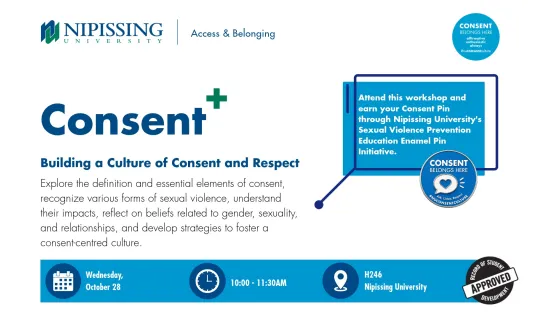
Consent+ is an interactive training designed to deepen participants' understanding of consent, sexual violence, and the broader cultural and personal dynamics that influence these issues. Through presentations, discussions, and reflection activities, participants will explore the definition and essential elements of consent, recognize various forms of sexual violence, and understand the impact of these behaviours in educational and social environments.
The training encourages critical reflection on personal beliefs related to gender, sexuality, and relationships while promoting empathy and accountability. Attendees will also learn about available support resources and develop strategies to foster a consent-centred culture in their communities.
- Length: 90 minutes
- Format: Available in virtual, hybrid, or in-person formats using slides and interactive discussions.
- Suggested Audience: New and incoming students
Key Learning Outcomes:
- Understand what constitutes consent and sexual violence.
- Recognize the prevalence and impacts of sexual violence.
- Identify various types of sexual violence, including how power and coercion affect consent.
- Critically reflect on personal beliefs shaped by social norms and media.
- Learn about available support resources for survivors.
RSD Competencies: Ethical Practice, Decision Making, Social Responsibility
The Building a Community of Consent workshop is designed to engage student leaders in building and promoting consent-driven communities. This interactive training encourages participants to critically examine the elements of consent, explore the principles of a consent culture, and reflect on the social barriers that hinder its development.
Through group discussions, brainstorming activities, and action planning, participants will explore the impacts of consent violations on communities, understand the role of sex positivity in consent culture, and develop practical strategies to integrate consent into their everyday leadership and interpersonal roles.
- Length: 60 minutes
- Format: In-person session
- Suggested Audience: Students in leadership positions, Upper year students
Key Learning Outcomes:
- Discuss the nine essential elements of consent.
- Define what a “community of consent” entails.
- Identify societal and cultural barriers to consent.
- Analyze the broader community impact of consent violations.
- Engage in action-oriented planning to promote consent in leadership roles.
- Model respectful behaviour and help foster inclusive environments.
RSD Competencies: Social responsibility, commitment and accountability, inclusion
Gender 101 Training is an interactive, introductory session designed to deepen participants' understanding of gender and its connection to sexual and gender-based violence. This training is grounded in trauma-informed, equity-oriented approaches and incorporates both lived experience and data-driven insights to foster awareness, empathy, and action.
Participants will explore foundational concepts such as what gender is, how gender-based violence manifests, and the systemic and societal factors that perpetuate it, particularly as they affect transgender and gender-diverse communities. Key Canadian statistics and studies are shared to highlight the disproportionate rates of violence and discrimination experienced by these groups.
- Length: 90 minutes
- Format: Available in virtual, hybrid, or in-person formats using slides and interactive discussions.
- Suggested Audience: New and incoming students
Key Learning Outcomes:
- Define gender-related concepts, including the distinctions between sex, gender identity, and gender expression.
- Understand how gender norms contribute to sexual and gender-based violence.
- Identify the disproportionate impacts on transgender and gender-diverse individuals using Canadian data.
- Recognize and challenge harmful stereotypes in media, language, and daily life.
- Explore how safety and inclusion vary by gender identity.
- Practice respectful behaviours such as using correct pronouns and intervening in discrimination.
- Commit to ongoing learning and advocacy in support of gender equity.
RSD Competencies: Equity and diversity, inclusion, social responsibility
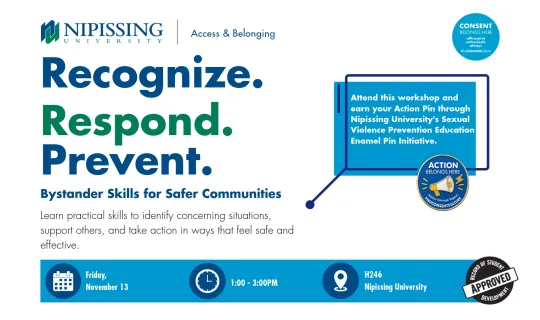
This interactive training equips participants with the knowledge and skills to recognize, respond to, and prevent gender-based violence in their communities. Grounded in research and the Courage to Act framework, the session explores common barriers to intervention, challenges harmful myths, and builds practical strategies for safe and effective bystander action.
Through reflection, discussion, and hands-on activities, participants will learn how to identify early warning signs of harm, apply multiple intervention approaches, and support peers in real-world situations. The training also emphasizes the importance of cultural and systemic change, encouraging participants to move beyond individual action toward creating safer, more equitable environments.
- Length: 90-120 minutes
- Format: In-person
- Suggested Audiences: Students in leadership positions, Upper year students, Staff and faculty
Key Learning Outcomes:
- Identify a range of gender-based violence behaviours, including less visible forms
- Explain common barriers to bystander intervention
- Demonstrate at least two bystander intervention strategies (5Ds)
- Challenge common myths and harmful beliefs about sexual violence
- Propose strategies to prevent harm at the individual and community level
RSD Competencies: Empathy, Conflict Negotiation, Social Responsibility
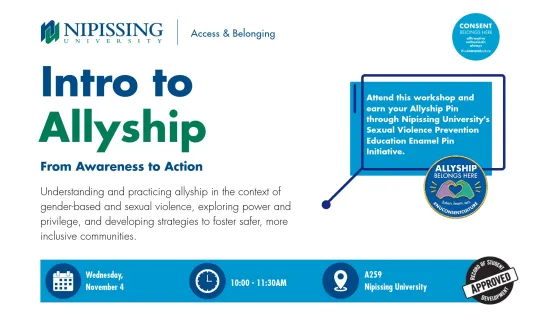
Intro to Allyship is a foundational workshop designed to engage participants in understanding and practicing allyship in the context of gender-based and sexual violence. Through interactive activities, data-informed insights, and reflective discussions, participants will explore the roots of sexual violence, the impact of power and privilege, and the role of allyship in fostering safer, more inclusive campus communities.
This training emphasizes self-care, empathy, and community accountability. It is part of Nipissing University’s broader commitment to equity, consent education, and ending gender-based violence on campus.
- Format: Available in virtual, hybrid, or in-person formats using slides and interactive discussions.
- Length: 90 minutes
- Suggested Audience: New and incoming students, Students in leadership positions
Key Learning Outcomes:
- Understand how sexual violence disproportionately affects marginalized groups, including LGBTQ2S+ individuals, Indigenous people, and students with disabilities.
- Reflect on personal identity and privilege using the Power and Privilege Wheel.
- Learn actionable allyship strategies, including support, intervention, and accountability.
- Practice meaningful apologies and address harm with care.
- Identify personal steps along the Allyship Continuum from apathy to advocacy.
RSD Competencies: Empathy, Equity and Diversity, and Inclusion
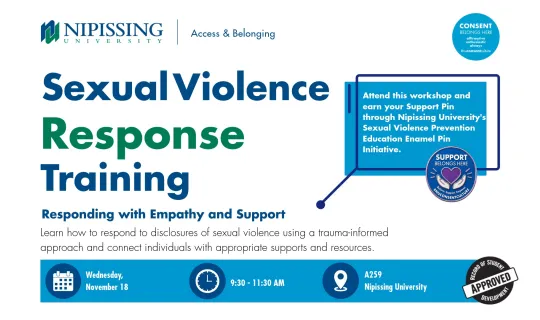
Sexual Violence Response training is designed to enhance understanding of sexual violence and its community impact. Participants will learn to recognize various forms of unwanted sexual behaviours and explore the psychological, social, and emotional effects on survivors. The training focuses on developing skills for providing supportive responses to disclosures while addressing confidentiality issues. By the end, attendees will be equipped to handle disclosures of sexual violence with confidence, empathy, and respect.
- Length: 2 hours
- Format: Available in virtual, hybrid, or in-person formats using slides and interactive discussions.
- Suggested Audiences: Students in leadership positions, Upper year students, Staff and faculty
Key Learning Outcomes:
- Define sexual violence as an umbrella term for various unwanted sexual behaviours.
- Increase awareness of the emotional, social, and psychological impacts on survivors.
- Build confidence and skills to respond to disclosures with empathy and care.
- Know how and when to seek help for oneself or others.
- Navigate confidentiality responsibly, understanding when information can be shared.
RSD Competencies: Empathy, Critical Thinking, Inclusion, Emotional and Interpersonal Intelligence, Leadership
Sexual Violence Prevention & Response Certificates
Are you interested in learning how to build safer spaces for individuals impacted by gendered and sexual violence?
The Sexual Violence Prevention & Education Outreach team offers a series of virtual and in-person workshops that focus on building our awareness and skills to respond to disclosures and build solidarity for survivors.
Students who complete each of the following workshops will be eligible to receive a Sexual Violence Prevention Certificate:
- Consent+
- Gender 101
- Intro to Allyship
Students who complete the above workshops in addition to the following workshops will be eligible to receive the Advanced Sexual Violence Prevention & Response Certificate:
- BITB (Bringing in the Bystander)
- Responding to Disclosures: Sexual Violence Response Training for Students