
This directory provides links to the three faculties, schools, academic and administrative departments.
Quick access to employee contact information.
Nipissing is a progressive and exciting place to work. Check out our job opportunities website for positions that may be of interest.
Find all the links to student services, and many other resources, that you'll use throughout your studies at Nipissing.
Everything you need to know about costs and how to fund your education can be found here.
Customize your learning experience in our Applied and Professional Studies, Arts and Science, and Education degree programs.
Located within driving distance of Orillia and Barrie, programs include Child and Family Studies, Culture and the Arts, Liberal Arts and teaching options.
Earn a BA (Honours) in Contemporary Studies from Laurier and a BEd from Nipissing as well as practice teach in the Public or Catholic schools near Brantford.
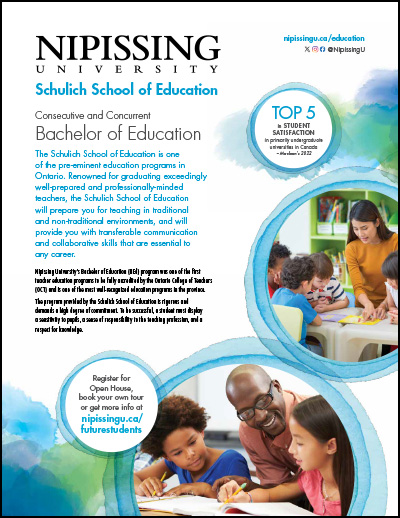
Nipissing University's Bachelor of Education (BEd) program was one of the first pre- service teacher education programs to be fully accredited by the Ontario College of Teachers (OCT).
The Bachelor of Education (BEd) program is a one-year full-time professional program that meets the requirements of the Ontario College of Teachers for teacher certification (Certificate of Qualification). It is open to applicants presenting proof of graduation with an approved undergraduate degree from an accredited university. The program provided by the Schulich School of Education is rigorous and demands a high degree of commitment. To be successful, a student must display a sensitivity to pupils, a sense of responsibility to the teaching profession, and a respect for knowledge.
Candidates may apply to enroll in one of three divisions in the program:
P/J -- Primary/Junior (Junior Kindergarten to Grade 6)J/I -- Junior/Intermediate (Grades 4 to 10)I/S -- Intermediate/Senior (Grades 7 to 12)
Students will complete courses in curriculum studies, curriculum methods, and foundations in education. In addition, there are two practice teaching sessions for a total of 12 weeks of placement in elementary and secondary schools throughout the province.
Upon successful completion of the one-year professional program, students will receive a Bachelor of Education (BEd) degree. A 70% overall average is required for graduation, with a minimum of 60% in each course and successful completion of Observation and Practice Teaching (Practicum). The program also meets the requirements of the Ontario College of Teachers for the Certificate of Qualification.
Basic Program Components
Curriculum Methods - This course focuses on studies of instructional techniques and technology, including computer usage in the classroom. Some of the topics covered are appropriate professional teacher behaviour, teaching strategies, lesson planning and evaluative techniques. Also emphasized are the study of the operation and use of audio visual aids, competency in the educational applications of information technology, and the application of teacher materials.
Curriculum Studies - These courses examine the aims, scope, sequence and structure of the major subject areas. In the primary, junior, and intermediate divisions, these areas are visual arts, language, mathematics, music, health and physical education, science, and social studies. The basics of each subject are introduced, but mainly in relation to the development of curriculum. Studies in the senior division focus on curriculum theory in relation to their teaching subjects.
Education and Schooling/Educational Psychology, Special Education - These courses provide an introduction to the major components of education. These include history, philosophy, psychology, sociology, administration, and a study of the needs of exceptional children. The courses provide background knowledge and evaluative skills for curricular decisions.
The Practicum - There are two practice teaching sessions for a total of 12 weeks of placement throughout the academic year. Students may practice teach in either the Public or Roman Catholic Separate School Boards in selected areas throughout the province.
Optional Courses
In addition to the required BEd courses, the Schulich School of Education offers a number of option courses. These courses are taken concurrently with the one-year program and are in addition to it. Following are the option courses:
Religious Education in the Separate Schools - An introduction to the curriculum concepts which compose the religious education curriculum currently in use in the Roman Catholic Separate Schools of Ontario; examination of scripture; Christian anthropology; psychology of religion; liturgy and sacraments.
Education of Native Canadians - An examination of the cultural and social aspects of Aboriginal Canadian life relevant to education; the legal, historical and sociological aspects of Aboriginal Canadian education; an introduction to teaching in Aboriginal Canadian schools; a practicum involving Aboriginal students is encouraged. Practicum in this course is conditional on acceptable practice teaching within the regular program.
Kindergarten: Curriculum Theory and Practice – The context of the kindergarten classroom is unique. This course explores relevant learning theories, current research, policy changes and curriculum design for the kindergarten classroom. Teacher candidates will explore the ways in which families, members of the community, early childhood educators and teachers interact during the education process to provide a strong foundation for students’ intellectual, physical and social development. Curriculum expectations, methodology, essential elements and resources for Junior and Senior Kindergarten programs, will be examined from an integrated studies perspective. Primary/Junior students may be given preference over others for this course.
Mental Health Issues in School Populations - This course is for persons preparing to be educational leaders. The intention of the course is to create awareness in educational leaders of the nature of mental health issues common in school age populations. Course participants will examine means by which students experiencing mental health issues, or who come from families experiencing mental health issues, may be identified and served. Measures that can be taken by administrators to support teachers working with students experiencing mental health issues are a major focus of the course. Another major focus of the course will be the actions administrators may take to create support for students experiencing mental health issues, effective ways of working with their parents, and with other agencies to better serve these students. Common concerns of teachers and administrators, such as the management of students' medications in the school setting, will be addressed. NOT OFFERED IN 2011/12.
Music Education through Technology – This course will introduce students to basic music concepts through the use of MIDI technology. The primary goal is to provide students with the rudimentary skills necessary to teach music in Junior Kindergarten to Grade 8 classrooms. NOT OFFERED IN 2011/12.
Outdoor and Experiential Education – This is a course where pre-service teachers will participate in experiential based activities in an outdoor setting. Through integrating curriculum (Junior Kindergarten to Grade 10) and Interdisciplinary studies (Grade 11-12), the participants will examine the knowledge, skills and values necessary to develop and implement outdoor education programs. Pre-service teachers in this option course will be involved in planning, teaching and evaluating outdoor education activities. They will spend a minimum of two weekends in an outdoor environment, have classroom instruction and participate in reflective online discussions.
ESL Across the Curriculum - This course is designed to prepare pre-service education students to meet the needs of students whose first or home language is other than English, and who are learning the language of instruction at the same time as they are learning the curriculum. The course will also provide background information about linguistic and cultural diversity and the immigrant experience, so that pre-service education students can better understand the background/life experiences and educational needs of students of various linguistic and cultural backgrounds. Students are required to participate in our practicum placements on the reserve or overseas or tutor a group of ESL students at their regular practicum placement. NOT OFFERED IN 2011/12.
International Teaching - This course explores educational, political, social, economic, and cultural perspectives and issues in various international contexts. Alternative practice teaching placements are enriching experiences that provide students with opportunities to explore personal subjectivities and their developing world views. Although a natural extension of the course, an international placement is not required for successful completion of the course.
Application of Multimedia Technology in Education - This course is designed to give preservice teachers of all technological skill levels an opportunity to develop an increased awareness of emerging multimedia technologies and their application in teaching and learning. Emphasis will be placed on experiential activities; enabling students to acquire skills required to apply multimedia technology in a school setting. Successful students will create a variety of multimedia projects relevant to their divisional focus. NOT OFFERED IN 2011/12.
Teaching in French Immersion - This course would be of interest to BEd candidates interested in French Immersion for K-12 learners. This course helps candidates develop the knowledge and skills necessary to teach in immersion. This course however does not lead to an additional qualification. Students must successfuly pass the French proficiency test to take this course. NOT OFFERED IN 2011/12.
Exclusion to Inclusion: Imagination and Creativity in the 21st Century Classroom - This course is a study of imagination and creativity development for K-12 learners. It is an introduction to alternative education with a focus on the interdependent relationships among philosophy, psychology, methodology, technology and education to inspire imaginative and creative teaching. The goal is to foster an attitude that values other ways of knowing, doing and expressing, and to challenge the teaching world taken-for-granted. This course will offer first-hand experience including a variety of imagination and creativity activities relevant to the classroom and to the practicum component.
© Nipissing University 2012 • Disclaimer • Privacy • Accessibility